—
Why 10 people gave their lives to God after gun-wielding man pointed weapon at pastor during funeral
By Leonardo Blair, Senior Reporter Tuesday, March 31, 2026
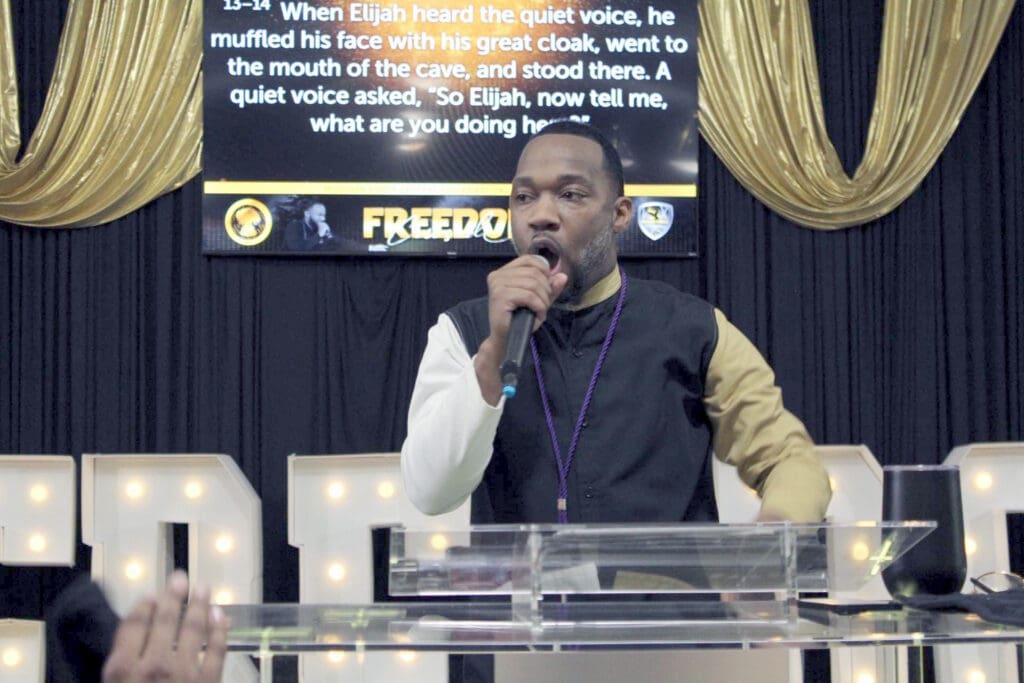
Pastor Darthanian Nichols of Breaking Chains Outreach Ministries in Detroit, Michigan, is also a licensed therapist and social worker. | BCOM
A pastor who managed to stay calm and prevent any casualties after a man pointed a gun at him during a funeral in Detroit, Michigan, on Saturday, is now being hailed as a hero by local police, but he has rejected the label and explained what led 10 people to surrender their lives to God after the encounter.
Pastor Darthanian Nichols of Breaking Chains Outreach Ministries previously shared that the unidentified gunman, who declared he didn’t believe in Jesus, pointed a gun at him as he was officiating the funeral for 17-year-old Jabari Malik Kenney, who died by gun violence earlier this month, and ordered him to be quiet.
The disruption at the New McFall Brothers Funeral Home, where the funeral was held, sent people scrambling for cover, but Nichols managed to talk to the gunman in a way that prevented him from firing a single shot.
“The pastor — the calm he kept and the way he handled himself — he’s a hero,” Detroit Police Department Capt. John Stewart said at a press conference cited by Fox 2. Stewart said the suspected gunman, who could face felonious assault and felony firearm charges, has since been arrested, and four other individuals were taken into custody for a variety of weapons offenses.
The Christian Post asked Pastor Nichols a series of questions about the encounter. What follows is a lightly edited version of his responses.
CP: How are you doing? You seemed to have continued with business as usual on Saturday night and Sunday morning. Was this adrenaline, or have you had a moment to reflect since that moment when you thought the gunman would have surely shot you?
Pastor Nichols: I’m doing OK. I had just gotten back home early that morning from a mission trip, so I was already moving on very little rest. But one thing I’ve always lived by is this: to whom much is given, much is required. Because of that, stopping wasn’t really an option for me in that moment; I felt a responsibility to keep going and to show up.
Looking back, I think a lot of what carried me through was a combination of adrenaline, faith and the peace of the Lord. It’s hard to fully explain, but in that moment, there was a grace that allowed me to function, even when everything around me felt intense.
Now that I’ve had some time to slow down and reflect, I find myself replaying it in my mind, asking, “What could I have done differently?” That question keeps coming up. Not from a place of regret, but from a desire to understand, to grow, and to be even better prepared in the future, and how to better try to reach people.
At the same time, I recognize that I did the best I could with what I had in that moment. And I’m trusting that even in the questions, God is still present, still covering and still teaching me through the experience.
CP: You said you are a trained clinician; can you elaborate a bit more on that? Are you a licensed counselor or therapist in addition to being a pastor?
Pastor Nichols: Yes, I am a licensed clinical social worker and therapist, and I currently serve as the Chief Operating Officer at Motor City Center for Hope. In this role, I have the privilege of combining both my clinical expertise and leadership to help guide an organization that is deeply committed to serving the mental and behavioral health needs of our community.
I truly believe that I work alongside some of the most skilled, compassionate and dedicated therapists in the city of Detroit. The level of care, professionalism and heart that our team brings to the work each day is something I take great pride in. We are not just providing services, we are creating spaces for healing, growth and restoration.
What has uniquely shaped my leadership, both in the church and in the workplace, is the combination of my spiritual and pastoral training with my clinical background. My pastoral experience has given me a deep sense of compassion, discernment and a heart for people, while my clinical training has equipped me with the tools, structure and evidence-based approaches needed to support individuals effectively.
CP: How exactly were you able to calm the gunman? What happened? Was he removed from the service?
Pastor Nichols: I’m not sure if I was ever truly able to calm him down. Looking back, I think what I was doing in that moment was less about de-escalating him directly and more about trying to connect with him and his emotions in a way that created a distraction, something that could help stabilize the room and keep the situation from escalating further.
My focus became maintaining as much order and safety as possible for everyone present. Even though I was engaging with him, I was also very aware of the larger environment and the need to keep things from spiraling.
He did end up leaving the service, which ultimately helped de-escalate the situation.
In the middle of it all, I remember sensing God clearly saying, “Keep talking.” And that’s exactly what I did. I stayed on the microphone, stayed present, and continued speaking not just to him, but to the entire room to help keep people as calm and grounded as possible.
CP: You appeared to have experienced a flood of conflicting emotions during that moment. Do you credit God’s supernatural peace for how you were able to manage the moment?
Pastor Nichols: Absolutely. In that moment, I remember feeling the weight of every role I carry all at once. It was like everything in me had to respond simultaneously.
I had to respond as a husband concerned about the safety of my wife. As a father aware of the need to protect my children. As a pastor responsible for covering and leading my team. As a social worker {I was] assessing the situation and thinking about the safety and well-being of everyone in the room.
And then there was another layer. I had to respond as a man who understands grief, anger and what it feels like to be overlooked. There was a part of me that could see the hurting young man behind the behavior, and my heart was trying to reach him even in the middle of everything that was happening.
It felt like I was being pulled in multiple directions, trying to hold all of that together in real time. But what I also recognize now is that it wasn’t just me operating in that moment.
There was a supernatural grace that met me there. A peace that didn’t come from logic. A steadiness that didn’t come from preparation. A clarity that went beyond my own ability to process everything happening at once. God gave me the capacity to stand, to think, to speak, and to respond under pressure in a way that I know was beyond my natural strength.
It reminds me of what Paul said in [his] First Epistle to the 1 Corinthians 9:22: “I have become all things to all people, that I might by all means save some.”
CP: You said 10 people gave their lives to God during the service. Can you describe how that happened? Did they see your handling of the moment as a testament to God’s power?
Pastor Nichols: This opportunity wasn’t created because of me. It really came about because the funeral home director, Julius Baker, made the decision to remain committed to their mission to serve the family no matter the circumstances.
When things shifted, and the decision was made to move the service to the cemetery, they reached out and said, “Pastor, we need you at the cemetery.” Even though my team strongly preferred that I not go, I felt a deep sense of responsibility and assignment in that moment. I knew I needed to be there to see it through.
So I insisted on going, and we were able to complete the funeral service at the cemetery.
That moment created an opportunity for me to deliver the eulogy with a very intentional focus, helping those present understand the promises of God, particularly the promise of eternal life for those who choose Him.
I also felt led to remind everyone that we are called to be the light of the world. And if we are truly going to be that light, it begins with us taking a personal look in the mirror, examining our own lives, our choices, and our relationship with God.
Because ultimately, the question is not just how we live here but where we will spend eternity.
CP: Have you spoken to the gunman since the incident?
Pastor Nichols: No, I have not spoken with the young man since the incident.
And I want to be clear about something, this moment is not about me. I don’t see myself as a hero in any of this. The focus should remain where it truly belongs, on a family that is grieving, hurting and trying to navigate an incredibly difficult loss.
My heart is with them, and I believe our community should continue to surround them with prayer, compassion and support. More than anything, they need love, covering and space to heal.
So I would simply ask that we keep this family lifted,