
Marriage rates for 18- to 29-year-old men have dropped considerably in the last 60 years, and the majority of these men feel isolated or lonely at least some of the time (as we found in in Parts 1 and 2 of America’s Demoralized Men). Around 4 in 10 young men have fewer than three close friends, according to our research, and around half believe that no matter how hard they work, people like them “will never achieve the American dream.”
Given these social conditions, it’s not surprising that 42% of young men feel like a failure. The story, however, is brighter for young men who attend religious services at least once a week.
According to data from the IFS Young Men’s Survey, which was conducted in April 2025, this group is more likely to be married than men who attend services less than once a year. Weekly attendees are also more likely to be very happy, to find life meaningful, and to have a bachelor’s or trade-school degree. At the same time, they are less likely to report ‘fair’ or ‘poor’ mental health.
Men and women choose faith traditions for their spiritual benefits, presumably, rather than their earthly ones. Nevertheless, the differences in outcomes between religious and secular young men are worth exploring, as it’s possible that recent declines in religious attendance for this population may help explain some of the challenges they face.
Marriage is More Common for Religious Young Men
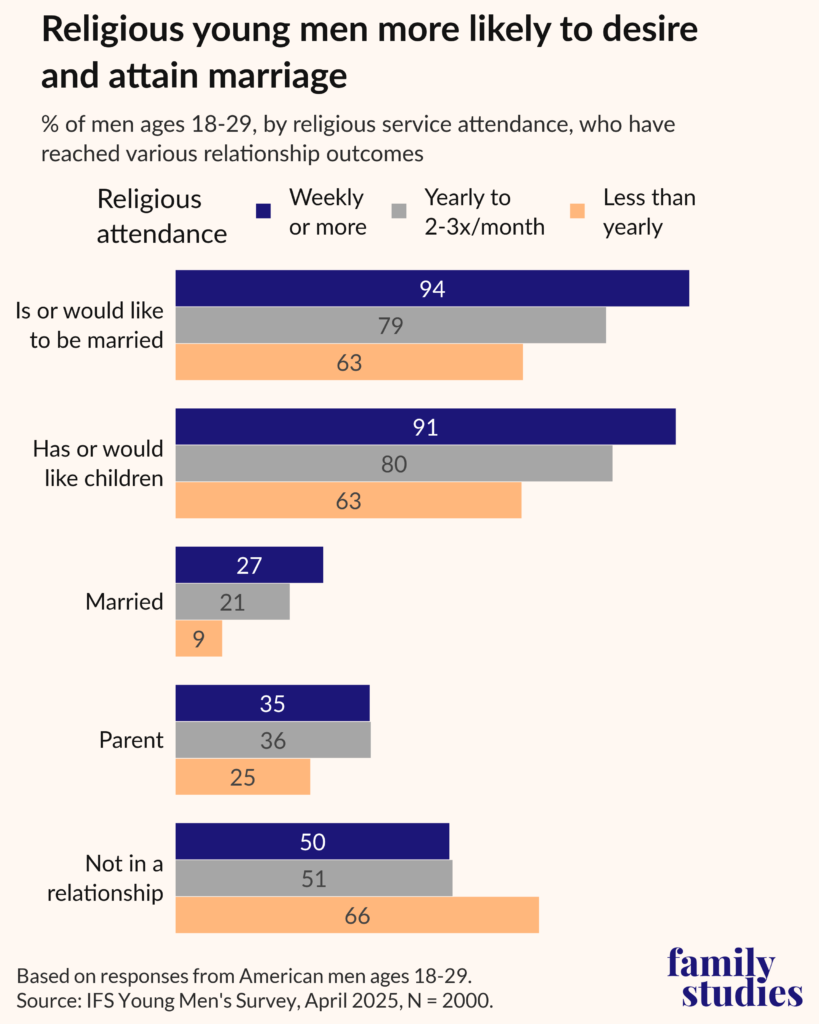
We found a positive connection between religious-service attendance and marriage: 27% of religious1 men ages 18-29 are married, compared to just 9% of secular men. In addition, 94% of weekly attenders either desire marriage, or are already married, versus only 63% of those who attend less than yearly. Similarly, relative to their secular peers, religious young men are more likely to have, or want to have, children.
Secular young men are also less likely to be in a romantic relationship (including marriage). While half of religious men are not in a relationship, around two thirds of their secular counterparts have neither a spouse nor a romantic partner.
The fact that half of religious young men aren’t married, or even dating, does suggest that this group is still having trouble finding the right partner. However, the data also indicate that the situation for secular young men, both in terms of preferences and outcomes, is even more challenging.
Religious Young Men Have Better Well-Being
Some may assume that religious practice leads to worse mental-health outcomes. They might think, for example, that prohibitions of certain activities, an emphasis on morality, and adherence to a belief system all keep young men of faith from thriving.
However, the opposite is true. In fact, religious young men score better on various mental-health and well-being measures, on average, than secular men. For instance, 41% of religious men consider themselves “very happy” compared to just 24% of secular men. Secular men are also more than twice as likely to report fair or poor mental health (35%) as religious men (15%).
In addition, around two-thirds of religious men say that their life has purpose or is meaningful, while only 4 in 10 secular men say the same. Active cases of depression and anxiety are also more common among secular men than religious men.
The link between religious service attendance and happiness for young men is not a new trend. Data from the General Social Survey (GSS) shows that, for most decades since the 1970s (including the 2020s), men ages 18-29 who attend services weekly are significantly happier than those who attend less than once a year, even when controlling for age, race, education, and marital status.
Although marriage alone doesn’t explain the connection between religious attendance and happiness for men, it can further help predict which men consider themselves very happy. The following chart shows the percentage of an older group of men (those ages 25-64)2, by religious service attendance and marital status, who consider themselves very happy. In every decade from the 1970s onward, married men who attend services each week are more likely to consider themselves happier than unmarried weekly congregants.
Even so, religious attendance still plays a key role in married men’s happiness: for each of those decades except the 2010s, religious married men are happier than their nominal and secular married counterparts.
Religious Young Men Have Better Education Outcomes
Research indicates that many individuals lose their faith in college: According to Barna Research, around 7 in 10 studentswho start their college career as Christians will finish with a diminished faith—or no faith at all. Does the secularizing influence of college mean that religious men are less likely to have a bachelor’s degree?
Interestingly, our survey shows the opposite: Religious young men are far more likely (46%) to have a bachelor’s degree than nominal (29%) and secular men (16%). Similarly, a higher percentage of religious young men (29%) than secular young men (14%) have finished trade school or an apprenticeship program. (We do not, however, find a difference in trade-school attendance rates between religious and nominal men.) Although many men may lose touch with their faith in college, the data suggests that many others retain their faith background or join a new religious tradition.
One possible explanation for these findings is that older young men (i.e. those ages 24-29) are both more likely to be religious and to have graduated from a higher-education institution. However, we did not find a significant difference in weekly religious-service attendance between men ages 18-23 and those ages 24-29.
In addition, when looking only at men ages 24-29, we still find a major difference in educational outcomes by religious attendance. Within this older group, 61% of religious men have a bachelor’s degree, but only 40% of nominal men and 25% of secular men do. Furthermore, the percentage of religious men ages 24-29 who have graduated from trade school or an apprenticeship (36%) far exceeds that of secular men (16%).
Given these findings, it is not surprising that college-educated men are also more likely to attend religious services weekly (33%) than are men attending school for a bachelor’s (20%) and all other men (13%). These findings call into question the assumption, at least for young men, “that highly educated people are less religious.”
Weekly Service Attendance is Linked to More Friends
We also see an association between religious attendance and certain social benefits. Those who attend services weekly are more likely to have three or more close friends (68%) than those who rarely or never attend services (52%). Religious young men are also less likely to be lonely (18%) than secular young men (29%).
Previous research suggests that friendships made at one’s church, synagogue, or mosque can help explain the increased well-being of religious individuals. According to Chaeyoon Lim and Robert Putnam, religious social networks are linked to greater life satisfaction; however, these authors also note that “a strong religious identity” must be in place for such social networks to have that effect. Interestingly, the authors also report that, “even among respondents with a similar number of close friends … people who have more close friends in their congregations tend to be more satisfied with their lives.” Thus, the nature of religious friendships, and not just their quantity, may play an important role in congregants’ improved well-being.
Religious Young Men Are a Minority
It is evident that weekly attendance at religious services is associated with several positive outcomes. However, only a minority (18%) of men ages 18 to 29 visit a house of worship this frequently. The majority, 53%, attend less than once a year or not at all.
Certain groups of young men are more likely to attend services regularly than others. For instance, 28% of conservatives report weekly attendance, whereas only 14% of moderates and 17% of liberals do. In addition, full-time and part-time workers are more likely to attend weekly than those who are not working.
We also find that young men’s own marital status, and that of their parents, predicts religious attendance. For example, 32% of those who are married attend services weekly, double the rate of those who are unmarried (16%). In addition, 22% of those whose parents were married when they were 16, but only 13% of those whose parents were not, attend religious services weekly.
This low weekly attendance rate among young men is not a new phenomenon: Since the 1970s, only a minority of young men have attended religious services on a weekly basis. However, wee