In October 2021, professional medical and hospital associations declared a “national state of emergency” in children’s mental health. While problems intensified during the pandemic, there were plenty of things to be concerned about leading up to it: rising rates of depressive episodes, sadness, suicidal ideation, hospital admissions for self-harm, and suicides.
While these problems have by no means disappeared, the good news is that the direction has shifted for the first time in 10 to 15 years: youth mental health has improved since 2021 by nearly every measure.
First, the Good News
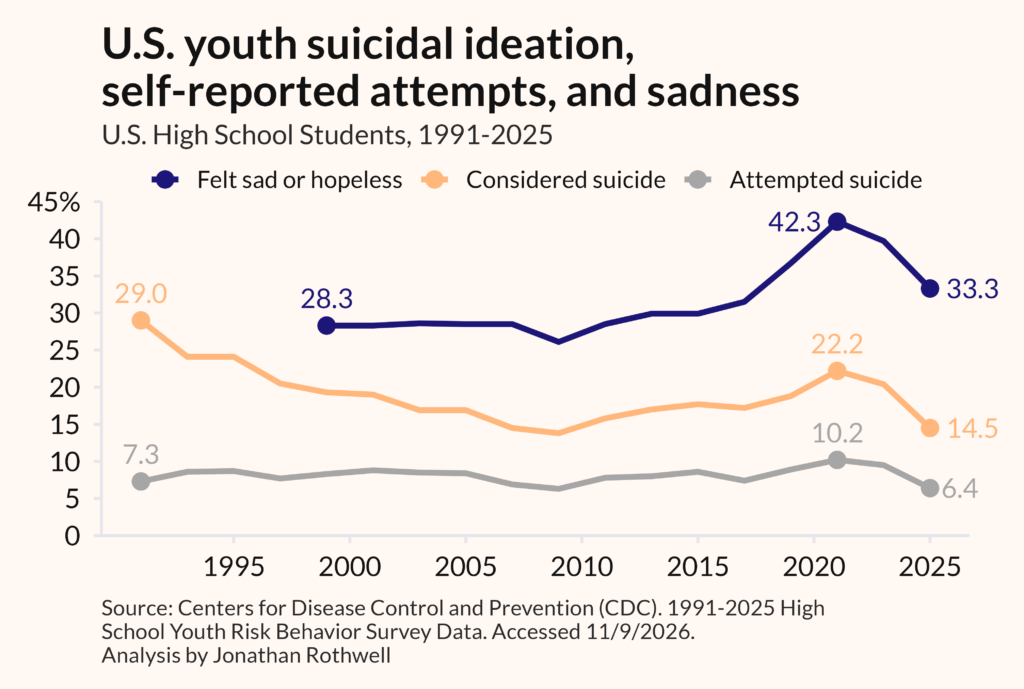
Among U.S. high school students, there has been a major reversal in suicidal ideation and self-reported feelings of sadness and hopelessness between 2021-2025, according to data from an ongoing CDC survey of U.S. high school students, the Youth Behavioral Risk Survey (YRBS).
The share of high school students who reported feeling so sad or hopeless for at least two consecutive weeks that they stopped doing their usual activities fell from 42.3% in 2021 to 33.3% in 2025. This was a notable drop after a steady increase starting around 2011.
Likewise, the share of students reporting a suicide attempt fell from 10.2% in 2021 to 6.4% in 2025. Serious considerations of suicide also dropped from 22.2% to 14.5 percent. The recent figures are both below the average going back to 1991.
Not a Complete Victory
Objective data on mental health largely confirm positive changes since 2021. For 15-to-19-year-olds, the rate of hospitalization from intentional self-harm soared by 90% from 2009 until 2021. This was only partly explained by changes in data collection. Yet, from 2021 to 2025, the hospitalization rate due to self harm declined by 11 percent.
Adolescent suicide data go back to 1968. Suicide rates spiked during the late 1980s and into the 1990s before falling until 2007. Since then, rates shot back up, peaking in 2017 but remaining high throughout and even after the pandemic. Unfortunately, the most recent data (provisional for 2025) still show adolescent suicide rates twice as high as in the 1960s.
Fortunately, deaths from self-harm among adolescents are 50 times less common than hospitalizations for self-harm, meaning the vast majority of those hospitalized survive. Still, suicides rates should be seen as a meaningful barometer of extremely low well-being.
What Explains These Trends?
It is difficult to identify causes from short-term trends, particularly at a population-wide scale. One reason is that the composition of young people is always changing. People born in one year may differ from those born before or after them, and not just in their exposure to technology, like smartphones. Moreover, even the best surveys only scratch the surface of well-being and its causes, leaving many important things unmeasured.
As I’ve written before, the most fundamental source of youth mental health is the quality of the relationship between teens and their parents. But the major public health surveys do not measure parenting or parent-child relationships, except in limited ways.
For example, the YRBS asks how frequently a parent insults or physically harms a child, leaving out all the positive aspects of parenting. Still, this variable has the strongest association with youth sadness and suicidality of any in the database. The survey also measures whether the parent knows where their teens are going or what they are doing. I find that this monitoring item also positively predicts mental health, though weakly.
The most fundamental source of youth mental health is the quality of the relationship between teens and their parents.
Another survey, the Substance Abuse and Mental Health Services Administration (SAMHSA), goes further. It asks children whether their parents require them to perform chores, restrict electronics use, and limit nights out. The survey also has two items measuring parental emotional support and one item about the frequency of conflict. While these measures do not fully capture relevant parenting constructs, taken together, they explain a large share of the variation in youth mental health, far more than parental income, race, or gender.
Moreover, religious children are more likely to report that their parents do these things—require chores, set limits, bestow encouragement—than non-religious parents. In fact, the connection between religiosity and parenting is far stronger than income or race and parenting.
Thus, it is meaningful that while episodes of major depression in youth declined from 2021 to 2024 in the SAMHSA data, religiosity—measured by importance of religion and attendance of worship services—increased over the same period, after dropping rapidly starting around 2012. The pandemic, it seems, accelerated a drift away from religious life that has since been reversed, albeit only partially. My analysis of these data also show that religious children are also less likely to be anxious, depressed, or suicidal, so the increase in religiosity could partly explain the recovery of mental health.
Other explanations are possible, but less clear. The pandemic—and the response to it in particular—likely contributed to significant mental health problems among young people. But some of these problems began rising well before 2020, so the pandemic can’t be the only explanation.
To combat the mental health crisis, public health advocates called for more spending on healthcare and more robust insurance coverage. But insurance coverage cannot explain the rise and subsequent decline in adolescent mental health problems. Coverage increased sharply during the period of rising issues with mental health. Moreover, the incidence of major depression does not vary across insurance types: uninsured children did not experience higher rates of depression, nor did rates differ between those enrolled in private insurance and Medicaid.
Social media use and access to smartphones accelerated during the decade leading up to the pandemic and have shown a small negative relationship with youth mental health in the YRBS data and many other sources. However, it is unlikely that social media use among adolescents has substantially declined since 2021. Indeed, there is some evidence from the YRBS that it has not. Yet, thanks to the efforts of advocates like the scholar Jonathan Haidt and the Institute for Family Studies’ Family First Tech Initiative, many parents and school administrators have imposed restrictions on smartphone use in recent years.
Laws surrounding social media are also beginning to change. In the last few years, many states have issued guidance or even restrictions on smartphone use in schools, as well as various other regulations designed to limit youth social media use. Therefore, it is possible that more responsible use of technology at school and home has allowed young people to spend more time on healthy activities, including hobbies, sports, and recreation, which are showing signs of recovery.
Looking Beyond Annual Trends
While youth mental health is moving in the right direction, short-term trends can mask more fundamental causes and challenges. Modernization itself has coincided with lower fertility, smaller families, declining marriage rates, and lower levels of religious belief and participation. This is concerning for many reasons, but among them is the global connection between parental religiosity and parent-child relationship quality, as my other work has established.
Public health monitoring can track symptoms but fails to explain the broader picture. Parents always have been and always will be of fundamental importance to their children’s well-being. Getting those relationships right should be the primary goal of every endeavor to protect and improve children’s mental health. With the acute sense of crisis beginning to recede, we now have the opportunity to think more clearly about the long-standing and fundamental causes of youth well-being. By doing so, we can confront the remaining challenges, which are formidable, in the wake of a decades-long transformation of society.
Jonathan Rothwell is the Principal Economist at Gallup and a Nonresident Senior Fellow at the Brookings Institution. His forthcoming book, Ancient Parenting: What the World’s Best Parents Do Differently to Raise Thriving Children (February 2027) can be preordered now.
—
by Jonathan Rothwell (@jtrothwell)
In October 2021, professional medical and hospital associations declared a “national state of emergency” in children’s mental health. While problems intensified during the pandemic, there were plenty of things to be concerned about leading up to it: rising rates of depressive episodes, sadness, suicidal ideation, hospital admissions for self-harm, and suicides.
While these problems have by no means disappeared, the good news is that the direction has shifted for the first time in 10 to 15 years: youth mental health has improved since 2021 by nearly every measure.